
Masterclass: Three Lessons from new Water

I hate leaving my home province, but I love exploring new rivers. For me, some days the need to explore outweighs the desire for familiarity. The opposite is also true, and the day I left for Wyoming I simply felt conflicted—you know what they say about leaving trout to find trout.

As the plane climbed out of Denver, I stared out the window at pillars of cumulonimbus clouds discharging lightning onto the Rockies below. Exhausted from the nine hours of travel, I couldn’t help but peer with childlike fascination at the geography and the weather below as the pilots maneuvered between the thunderheads.

Nine hours of boarding and deplaning didn’t help me overcome the pull back toward the familiar. You’ll still be casting flies in the Columbia River Drainage I told myself. You’ve done that your entire life. The Columbia River Drainage is enormous and draws water primarily from tributaries in British Columbia, Washington State, Idaho, Montana, and Wyoming. Still, my nine hours of travel had more to do with scheduling issues and less to do with distance. I’m almost certain I could have driven to Jackson from my hometown in the same amount of time it took me to fly with all the layovers and delays.

Perspective, I remind myself, that’s why I do this. Moving beyond the familiar enables me to learn more by broadening my perspective. For example, whenever I struggle to move beyond conflicting thoughts, I play a little game of mental gymnastics, and it goes something like this. I tell myself that a BWO is both small and big.  A BWO is small compared to an October Caddis which is small compared to a Golden Stone. But a BWO is large compared to a midge or a Trico, and a Golden Stone is small compared to the spider that crawled out from my woodpile the other day. The same is true when I move between the familiar and the unknown. If I constantly fly-fish familiar streams, I eventually arrive at a place where I feel advanced in my skillset. Over time, I figure out the puzzle. When I travel to new places and fish new rivers, I’m faced with a new set of variables so I’m forced to return to the role of learner and observer. Flying into Jackson at night with the dark and jagged Grand Tetons outlined against the moonlit sky, made me nearly forget about the travel day. Excitement started to seep in as I began to think about the days ahead. I’m about to land in one of the world’s most beautiful trout-fishing classrooms to learn from some of fly-fishing’s best professors.
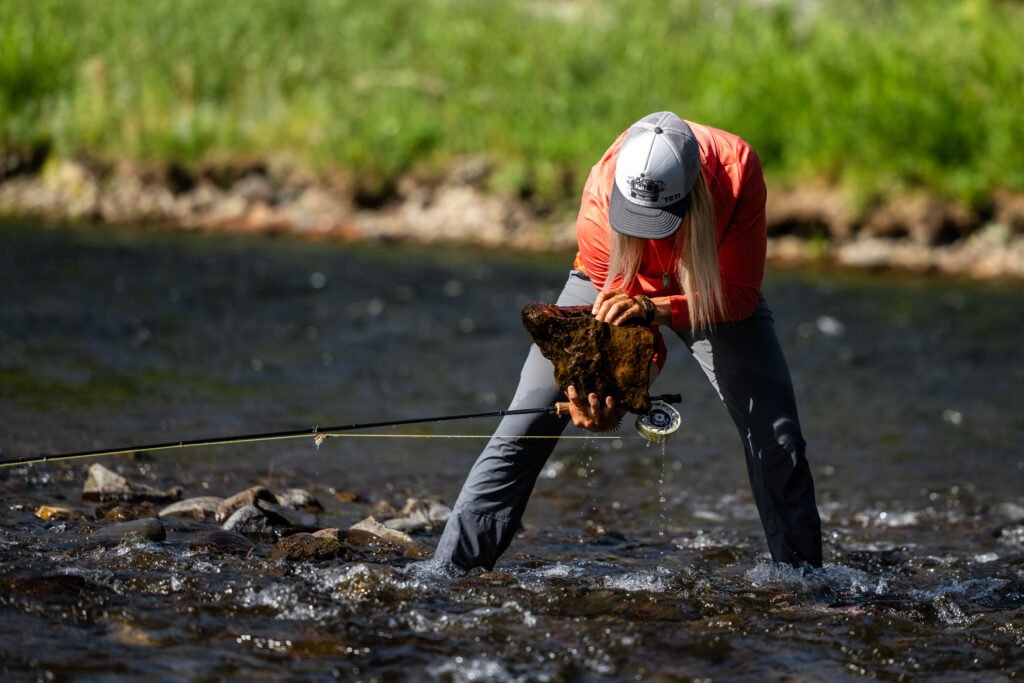
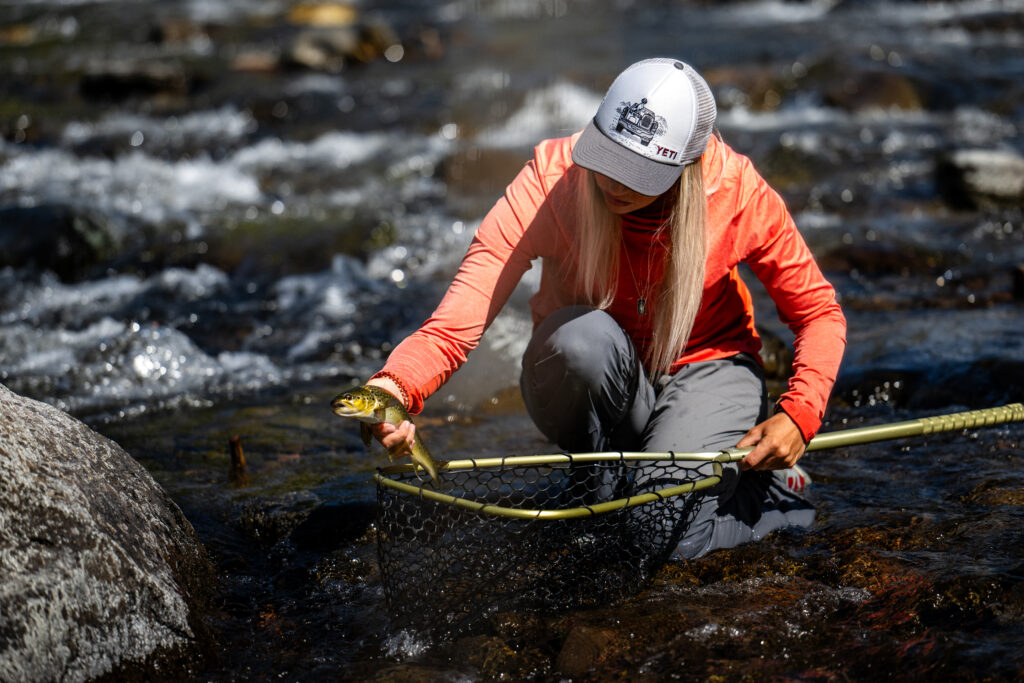
The first few days on Wyoming rivers helped me to further forget the travel thorn until one of my cohosts missed a connecting flight because of another late connecting flight. Paula Shearer, an all-star guide from Calgary, Alberta, was scheduled to fish with me for two episodes…one on the Green River and one on a stream in Yellowstone National Park.

She missed the Green, but when Paula did arrive, she was primed to fish in the Yellowstone region. Paula tackled the first run, a juicy piece of confluence water with ample depth. I watched as she made the first few casts, and then I moved upstream a hundred yards or so where a medium-sized, downed pine broke the flow of the current and created a feeding lane. I looked around for bug activity, and didn’t see any, so I slipped tippet through the eye of a brown-bodied Elk Hair Caddis and hoped for the best. Sure enough, a fish rose to the fly and moments after I dipped my net into the water and led the trout to it. Just a small trout, but a trout to start the day nonetheless.

Paula didn’t get anything in the first or second hole she cast into, so at that point I felt pretty good about my one small trout. I’m not sure if it was jetlag or uncooperative trout that affected Paula, but by the third run, I decided to sit back and observed the way she approached a slow start to the fishing day.

This run didn’t look overly special as far as runs go. The first two actually appeared better. The far side ran through fast, but about half way to the near side the run slowed a little and gained a few feet of depth. Paula stood in deep grass between a large boulder and a large conifer tree. She tied on a foam-fly and a small fish rose on her first cast. She landed and released the trout. Then she did it again, and watched as a small trout rose. She landed that one as well.

After a few fish in as many casts, she changed tactics, which as a fly angler is difficult to do when you’re experiencing some success. In fact, small successes can be a fly angler’s largest obstacle. When small fish are coming to the fly, it’s easy to stay with that fly. Granted, sometimes small fish are all the stream holds, but sometimes small fish are coming up because they’re more easily fooled than the wiser, more educated trout. A versatile and knowledgeable fly-angler like Paula was willing to adjust methods in order find out for sure if small fish were the only fish in the stream.

She tied on a dry-dropper set up and coincidently proved there were larger fish in the run. A small trout took her dropper and then a large, brown trout attacked the small trout. She instantly reeled up, cut off the dry-dropper, upped the diameter of her tippet, and tied on a large streamer. She cast the streamer into the fast water and stripped. The 20-inch brown shot from the depths, grabbed the fly and then spit it just as quickly. She missed that one, but found a large brown behind a boulder a couple of runs upstream. You win some you lose some, but with the change from dries to streamers, at least she was winning big and losing big.

The next subtle reminder happened on the second day of a float trip on the Snake’s Southfork. Fishing here was kind of a “visions of sugarplums danced in my head” type scenario. I’d heard of the potential for big browns on this section of the river and hoped this would be the day we’d get one on camera. On this particular day, I was fishing with Jackson Hole fly-shop owner, Mike Dawes.

The day before we’d experienced some cutthroat success on Pale Morning Duns, but the ultimate hope was to bring a large brown or two to the driftboat. Mike, being a gracious host, offered me the front of the boat, to which I declined and said I wanted to watch him fish streamers for a while before I took my turn in the front. Mike encouraged me by informing me that the person in the back of the boat has the advantage because they can hit all the holds the person in the front of the boat misses. I felt a wave of short-lived confidence. After shoving off, I soon realized Mike was not the type of angler to miss casts. I guess more accurately, the back of the boat is advantageous when streamer fishing if the guy in the front of the boat is a crappy caster. The advantage from the back of the boat on this particular day was that I got to see Mike put on a streamer clinic.

It’s funny, because when I’m fishing new water, I instantly revert to what worked before in similar situations, which is normally chuck it at the bank and then strip like a mad fool. However, this can pay off in some situations and not in others. Streamer fishing can actually be highly varied. I’ve fished places with guides where this is the case. I’ve also fished places where the guide has asked me to do the exact opposite, where they ask me to drift the streamer beside the boat deep in the water column as we float downstream.

What I learned from Mike, besides the fact that he rarely misses a cast, is that on the Southfork, they fish streamers a little bit differently than other places I fished before, and I suspect it has everything to do with the flowrate and bank foliage. The Southfork is big water and it moves relatively quickly for a large river system. The section of river we fished didn’t have the picturesque slow flowing cutbanks. Instead, the banks were lined with what seemed to be an infinite number of places where the river undercut small trees and foliage producing large clumps and root chunks. The larger, brown trout and cutthroat claimed these undercuts as residents.

A few hours into the day I felt like I began to pick up on this rhythm. I started to hit the water a few feet above these turf chunks, let the fly sink for a few seconds to ensure it didn’t get fouled up on the roots, and then stripped the fly at a pace somewhere between the exact middle of dead drift and mad fool.

So, what’s the lesson here if I needed to sum it up? When you’re going to different places and the guide says you’re fishing streamers, don’t assume because you’ve successfully fished streamers that you’ll be successful in fishing them the same way on the new stream. You might, but you very well might not be. If you’re fishing with a guide, ask him about depth and retrieval speed. This could make an enormous difference in your day. It did for me.

Did I catch the brown that was dancing around in my head the night before. Unfortunately, no. I did catch lots of cutthroat, one of which was quite notable. But the browns that day eluded me. I had a shot at one near the end of the day when the cameras were off. Mike took the oars and rowed into a fast side channel with tons of fishy haunts. I cast a few feet in front of a gangly root structure and let the two-inch white streamer sink. I stripped once and hooked an enormous brown. As he twisted and turned, his buttery shadow reflected through the water column. However, one of his headshakes gave him his freedom, and unfortunately left me with nothing but a fish story about the big brown on the Southfork that got away.

This season Episode 4 turned out to be my favourite. It definitely didn’t start out that way. In fact, all I felt until about lunch was angst salted with a lining of stress. I did everything I could to relax, but my brain kept reminding me of a few key factors. One, there was a lot riding on this episode, and the stream and the fish were not cooperating. Two, I’m fishing with a local and national environmental legend, John Turner, and his son Mark. Three, we’ve only got a kilometre or so of river before the water turns into milk tea from the tributary that had a rain induced mudslide the day before.

The production team and I got together and talked about possibly changing locations, but then in the end decided to stick with the original plan, not because of good fishing, but because the park service rarely issued permits for the stretch we planned to fish. We assumed they only issued us a permit because we were filming with John.

No pressure, I kept reminding myself. John, the 80-year-old former director of the US Fish and Wildlife Service under George HW Bush, sat in the front of the boat, and I took the clean-up spot in the back. Near the end of the kilometre of clear water, John hooked a trout behind a small logjam. I felt some stress dissipate. Then John released the fish and turned to Mark and said, “Well, at least we got one today.” Five minutes later we passed the tributary and the Snake went dirty.

John remained calm. He chuckled often. He never reached for a fly box. He cast nonchalantly at times, and others he just simply sat back in the front seat and absorbed the relational geography of the day. He was on the river with his son, and nothing was going to steal the moment. Not a river that wasn’t cooperating or an anxious TV host or a camera crew. He accepted the reality of the moment and he flowed along with it, in the same way the Snake accepted its place below the towering peaks of the Tetons.

My panic spilled over into my fly box. I transitioned from small dry, to large dry, to dry-dropper. Then I ditched the dry-dropper and started deep nymphing. They all produced the same number of trout. Nil. Then when I went to a streamer, I witnessed the first sign of fish life in the murky water. A few trout chased and touched my small streamer but wouldn’t fully commit. The stress subsided a little more just before lunch as we pulled over and fished a small side-channel. A few trout rose, but neither John nor I could get them to rise to our flies. Still a sign of life. We could figure it out if the trout start helping out a little.

A few minutes after we ate lunch Mark said, “This bank up here is really good. Get ready.” And sure enough, John cast his small BWO pattern, the same fly he started the day with, toward the bank and watched it drift. A nice cutthroat came up and attacked the small, mayfly imitation. John landed the trout, a nice yellowbelly (what the Turners affectionately called Snake River cutthroat measuring above what appeared to be 15-inches).

I tied on a #16 Parachute Adams, peeled out line and then cast toward a root ball and watched with cautious hope. A large cutthroat left its lie. The Adams, after a light early-afternoon drizzle, proved to be too tantalizing for the 17-inch yellowbelly. With the fish in the net, I felt myself breathe for the first time that day. I’m in a boat, fly fishing with John Turner on the Snake River as it flows past the feet of the Grand Tetons. Wow…how did I almost completely miss enjoying this unique opportunity just because the trout weren’t doing what I expected them to do.

After lunch every section of river that looked like it should hold a trout, did. The stress of the morning evaporated as the day turned into what I hoped it would be.  What’s the grand lesson in this. Oddly enough, fly-fishing wise, it’s the exact opposite of the first lesson. Let the river do what it’s going to do. Enjoy the river, the mountains and the company you’re out there with. The river’s going to do what it’s going to do, and the trout are going to do what they’re going to do. Sometimes no amount of fly changes or stress or hopelessly staring at your fly box is going to change that, so make the best of what you can and the river will turn around when it decides to. You can’t change that. Some of the best fly anglers I’ve fished with over the years know this. I think I know this too, but knowing something and living it can be its own challenge.

The next morning, I walked into a fly shop in Jackson. The young fellow from behind the counter asked if he could help with anything. “No. Thank you though,” I replied. “I’m just here to check out your hats. I’m looking for a very specific one.” Then I described it to him.

            “We don’t have those hats. Sorry.” Then without skipping a second, he asked, “Where are you from?”

            “British Columbia,” I replied.

            “Wow! Why did you come down here to fish? If I was from there, I’d never want to leave.” He adjusted a pamphlet on the counter.

            “Yes. Me too,” I replied as I started to head toward the fly-shop door. I didn’t have time to explain the apparent contradiction. My brother and I had to meet the production crew in an hour and we had an hour and a half drive ahead of us. I never want to leave British Columbia and I always look forward to returning. I’ll also always want to return to the streams of Wyoming. I’ll never forget my time there, nor the people I fished with. I understand the two are opposing statements, but they’re both true in the same way a BWO is small and large depending on what you’re comparing it to.

Lesson 13 brought to you by Fly Fusion contributor Derek Bird and photographer Arian Stevens.  This article was originally published Volume 21, Issue 4 (Fall 2024)