


Who can deny the euphoric feeling of a well-thrown distance cast, the line hurtling across the river, outpacing every angler on the run?
Adding distance to your cast is not always necessary to target fish—as often, fish lie closer to the shorelines than not (always fish the dangle!). However, there are situations where distance casting can help you reach those far-off seams and mid-river structure, allowing you to meticulously place your fly into the swing zone, or pick up fish behind other anglers on the run.
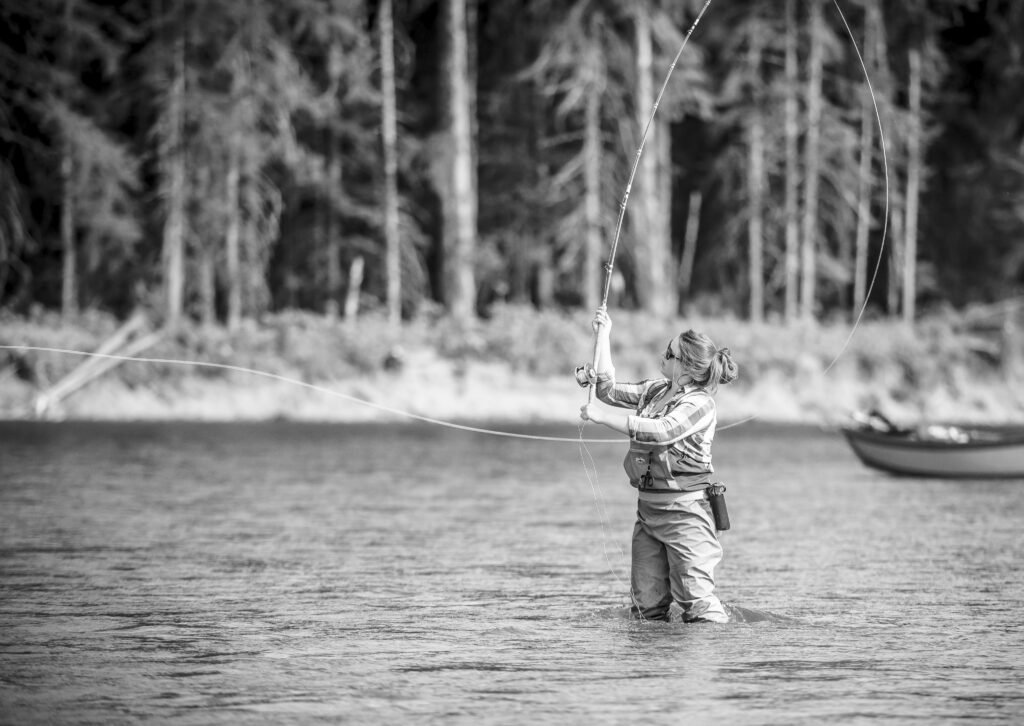
Anglers often associate power with distance, but Spey is a dance between you, the line and rod as an extension of your arms, and the current. Just like a dance, the more you overpower and force the steps, the harder they will come. Spey casting melds power and a fluid rhythm; there is a slow smoothness that conceals any pronounced muscular strength. If power is applied effectively, your line will have no other choice than to dart through your guides and explode into a V-shaped projectile across the river. Like a dancer, you’ve got to practice to get good. Practice will help you eliminate inconsistencies in your stroke and create the rote muscle memory needed to become a better Spey caster.
Fulcrum Salute
In order to begin to add distance to your casting stroke, it is crucial anglers understand the physics of the cast and the related body mechanics. One of the most misunderstood components of an efficient, powerful cast is how the angler’s top hand acts as a fulcrum. A fulcrum is a balanced pivot-point on a lever. Think of the base of a teeter-totter, or an oarlock. In a Spey cast, the top hand is the fulcrum, around which the rod pivots. How the rod pivots, and whether or not it does so with power, is in large part determined by how your bottom hand pulls. If it pulls with power toward your belly button or sternum while your top hand stays fulcrum-like at ear level, you can unload line from your rod more efficiently. If, instead, the top hand pushes, you’ll find much more resistance; like rowing a boat when facing the wrong way. If you leverage power by pulling down with your bottom hand, the pivot is much smoother and the cast is more efficient—which in our case leads to longer days on the river.
Wax On
Once, while in San Francisco for Spey-O-Rama, I wanted to get in some early morning practice before the competition. The revered Golden Gate Angling and Casting Club hosts the world championships of Spey casting, and as I experienced the glow of the morning sun cresting over the dew-misted gardens, the serenity was interrupted by a loud and guttural “hoo-wa,” followed by a thump. Was it Al Pacino in Scent of a Woman? The Karate Kid? I wasn’t far off. Out near the ponds stood a competitor practicing only his underhand pull. Sans rod, this Daniel-san of Spey would thunderously thump his chest as he pulled his bottom hand in. Simultaneously, he pushed away with his top hand, announcing the action with an audible “hoo-waaa!” If you didn’t know this was casting practice, you could easily mistake it for martial arts, but this competitor knew the importance of his fulcrum, and he knew the only way to achieve rote muscle memory was to get in his reps, even without his rod.
Less Death Grip, More Pie
We’ve talked about the importance of the top hand as a fulcrum, now let’s discuss the importance of the bottom hand as it correlates to line speed. The bottom hand is a key component in forming your D-loop (which loads the rod), as well as unloading the rod to give maximum line velocity. Oftentime casters pull their bottom hand in, stopping to unload the rod, but inadvertently put their top cork in a death grip. Yes, you have to hold on to make the stop, but anglers often squeeze too tight. Instead, try loosening your top hand so that you’re holding the cork between your thumb and first two fingers. Then, as you corkscrew up into your D-loop, your top hand will rotate in synchronicity, until the bottom of your palm is on top of your rod. When teaching this practice I tell my students to imagine they’re palming a banana cream pie. As you sweep up into your D-loop, you must ensure the pie doesn’t fall, then, once you reach the top of your sweep, imagine smashing this pie into someone’s face (maybe that angler who used to be able to out-cast you). By palming the rod’s uppermost cork, you’ll relinquish your death grip and allow your mind to focus on pulling, rather than pushing. By not dropping the pie and allowing your top hand to rotate over the top smoothly, you start to eliminate the habit of squeezing your rod, which, if you do too tightly, will deter any line momentum you may have gained.
In The Navy
The U.S. Navy Seals have a motto, ‘slow is smooth and smooth is fast.’ For anglers wanting to improve their casting, this phrase perfectly captures how to find power in our body mechanics and the technological potential of our equipment.
There is no punching your way through a cast; if you are not exerting proper force at the right moment, your cast will break down. When you watch the greatest casters in the world it is impossible to discern from where their power is being applied. Like a professional ballerina, everything looks beautifully effortless.
A cast is made up of steps, and if the steps are too clunky or too rushed, the line momentum will founder. Remember the Navy Seals: a slower, smoother cast is a faster cast. Even if you think you already have a slow, smooth stroke, try to slow it down even more. Experiment by slowing your cast to the point where you almost lose water tension. My guess is you’ll be surprised by just how much line you can still shoot. Just as a single hand rod takes time to load, your Spey cast will benefit as you find your power in slowness.
Creep Happens
In single hand casting, you often hear the phrases “watch your creep” and “add a drift.” Creep is when, at the end of your backcast, you allow your hand to creep forward before making the forward cast. Adding a drift is one way to slow down that motion.
In Spey casting the concept of creep is the same, but it shows up in a different part of the process. Consider the entire Spey cast process. It begins with the lift, a sweep to form the D loop and a pause to feel your load maximize. However, before the bottom hand pulls forward and the pie to the face rotation begins, creep can come in. It reveals itself when you do not wait for your D-loop to fully form and you fire forward before your rod is entirely loaded. For me, creep usually happens when I’m tired or overthinking, as I tend to rush. When I notice myself rushing and my cast begins to break down, getting shorter and shorter, I focus on adding a drift. Adding a drift in that sweet spot when you pause to feel your rod loaded will widen your stroke, which will in turn create more potential to create that deeper load.
Don’t Sweep Too Steep
As we speak about rod load, we must also note our sweep plane. Our sweep up, or corkscrew, must accelerate smoothly along a level plane across the body. Many casters will hold their rod as though it’s planted in a gimbal belt on a saltwater fishing expedition, however, when you hold your rod at too-steep of an incline as you sweep, it decreases any rising acceleration to build line energy. The flatter we can keep this plane, the more room we have to load our rod. The more room we have to load our rod, the longer we can make our forward cast stroke and the further we can fling our flyline.
Reel Simple
Big picture mechanics are fundamental, but there are small strategies, too, which you can incorporate into your Spey cast to gain maximum line speed. One of these is an outside reel rotation near the end of your cast.
At the top of your lift, as you are rotating your top hand to push forward with our pie to the face technique, a slight rotation with your bottom hand will turn your reel 90 degrees as you push forward. This will allow for less birdnesting in your line loops.
There are several ways of holding your excess line, or loops. You can hold them in your top hand, pinched between your thumb and the cork, or tuck them like a lasso on your opened middle finger. You might also keep them on your bottom hand, looped around your middle finger. Regardless of which hand holds them, you don’t want your loops getting snarled when it’s time to launch that line. By rotating your reel, you are freeing up extra space, allowing your loops to travel through your guides without catching. A clean path for your running line to travel through equates to more speed, more distance and a better chance of reaching that far-off seam.
Axe Not How Hard, But How High
One of the last tactics that will make a massive impact on line velocity is stopping your cast hard and high. To create tighter loops, to force that momentum you’ve just created with your D-loop and to energize it into an upwards trajectory, we need to stop much higher than in single-handed casting. The longer rod dictates that higher stop; if you stop too low, your D loop will be forced downwards, resulting in lost momentum.
In single hand casting we hear the rule of 180—essentially, ensuring your rod tip does not deviate from a straight plane as it moves through the casting stroke. The same rule should be applied to spey casting, but again, with the longer rod, the stop comes at a higher point than you would think. Many anglers tend to use their rod like an axe, chopping down towards the water in order to stop. But chopping your rod down eliminates line energy. Stopping high retains that momentum and, as an added benefit, will also force you to use more of your bottom hand.
To Make a Short Cast Long
Adding distance to your cast feels euphoric. With any sport, there is a drive to continuously push your abilities, to reach your own maximum potential and to squeeze every ounce of technological potential out of our modern equipment. Learning how to incorporate all of the strategies discussed here won’t happen overnight, but mastering one step at a time will build your process towards hurtling V-darts across the water. Huge casts are certainly not necessary to catch fish, but there can be many situations where fish are lying mid-river and a well-executed power stroke can get you into the zone. Remember your greatest asset in distance casting is an effortless, rhythmatic smoothness, a yogic flow which masks any muscling. Slow your cast down, allow for maximum rod load with a flattened plane and an added drift, ease your top hand grip with a pie to the face palm push, fiercely pull the butt of your rod into your sternum from your top hand-fulcrum while rotating your reel face and stop hard and high. Easy, right? If your cast starts to break down, make a mental checklist: note where your fulcrum is, ensure good anchor placement and avoid adding a creep. Self diagnoses will help you become a better caster, give you a shot at new fish and prove to your muscle-bound buddy that big biceps don’t necessarily equal long casts. Listen to the music of the river and partner up with your equipment. An effortless dance awaits.