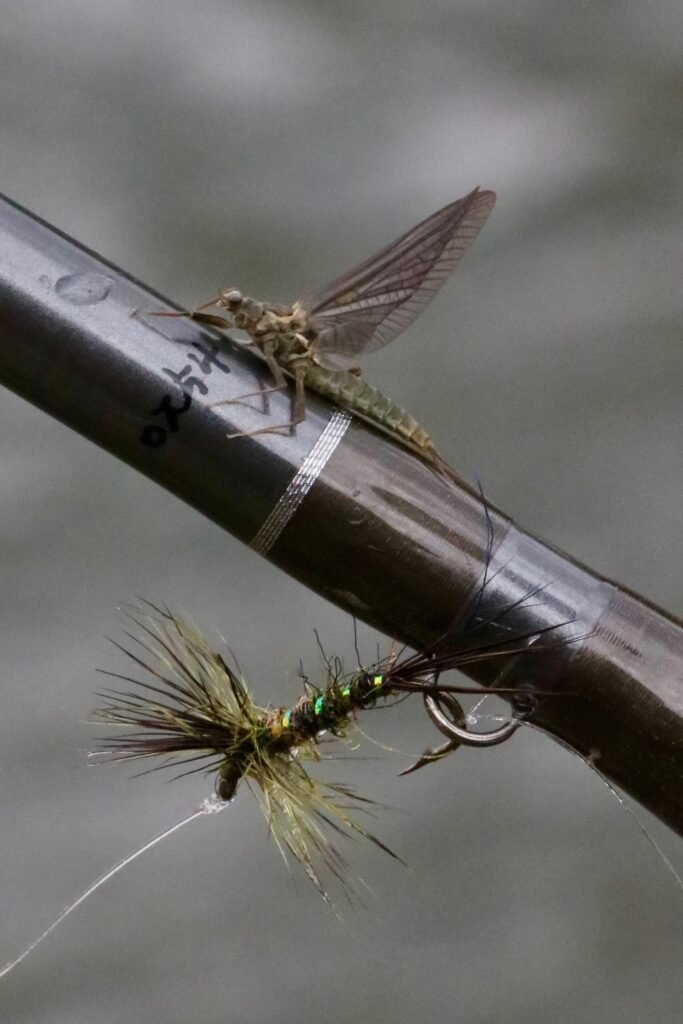
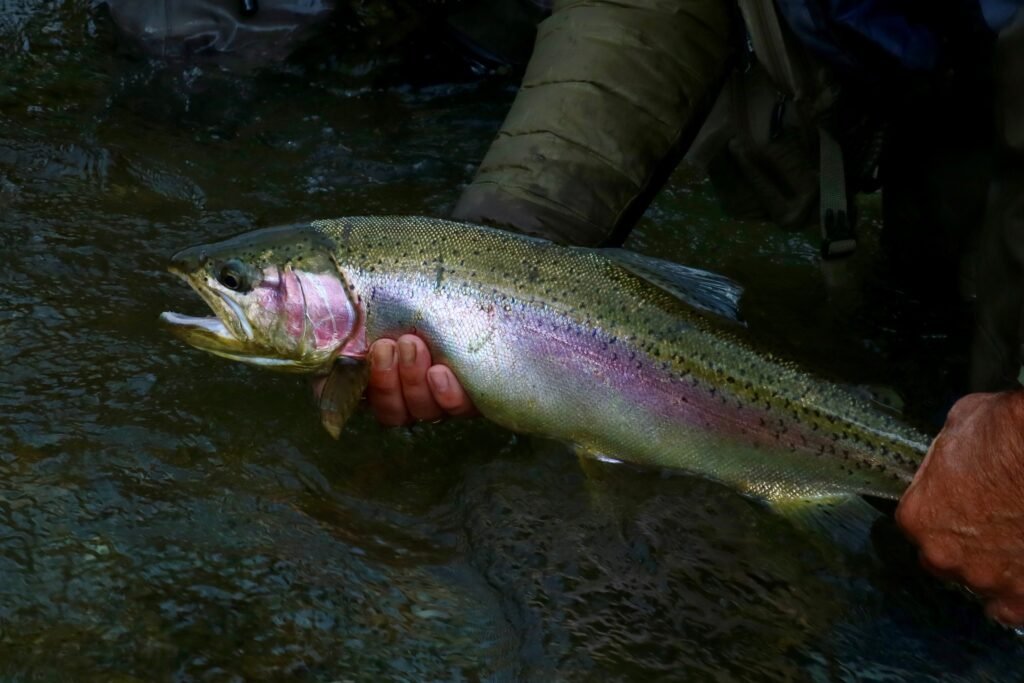
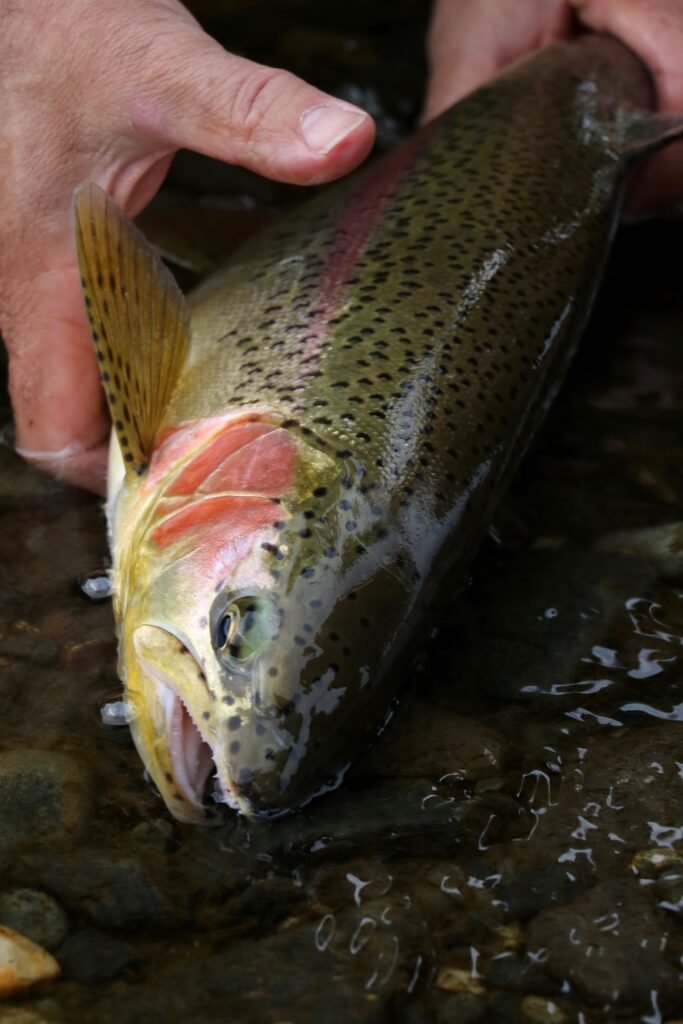
This episode got me thinking that while we should do all the “big things” properly by using the right flies and suitable leader, making a careful approach, avoiding drag etc. – sometimes success seems to depend as much on the little things as the big things. And when you’ve done all the big things you can do, there’s nothing left but little things. Here are some I’ve stumbled across.
Sometimes changing your position just a little makes it much easier to achieve a drag-free, acceptable-to-a-fish drift with a dry fly. A good example is when you’re working up a nice current seam where there is slow water along the bank and a strong current just a few feet out from the bank. If you stand on the bank and angle your cast up and out, the fly will land in the right spot on the edge of the current seam, but much of your fly line will lie on the slow water. As the fly drifts down the seam a right-angle bend will form in your line and/or leader. Once that happens you either have too much slack to set the hook if a fish takes, or the fly stops drifting naturally, resulting in a draggy drift that’s laughable to the fish. The solution is often to simply take a couple of steps out into the water (assuming, of course, that it’s safe to do so), and cast directly upstream so the fly line lands on water that’s moving the same speed as the water the fly is in.
Other times standing in the best place simply means getting to a spot where you can cast a comfortable distance rather than straining to the limit of your ability. Think about this before you start casting. Check the distance to the target, the currents between you and the target that may cause drag, and whether there is clear space for a backcast.
Move to the Other Side of the Creek
If you always find yourself casting from the “easy” side of the stream, as evidenced by the well-worn path along the bank, you’ll be doing exactly what everyone else does. You might also be throwing the same flies as everybody else if you happened to visit the same fly shop or website they did. Look the situation over. Although the walking or wading might be more difficult on the other side, you’ll likely have a less sophisticated audience of trout over there, and possibly an easier time getting a good drift. Of course you should only do it if it’s safe to cross.
Each time your fly finds its way into your hands for any reason – to tie it on, to take it off, to remove debris, to apply floatant, to attach weight to the leader – check to make sure the fly is still whole (ie no parts missing, not twisted around the hook, not torn up), and the hook is sharp. While you’re at it, check the tippet for wind knots and remove them or cut them out and re-tie with proper knots.
Okay, this is more of a big thing than a little thing, but it’s really important. It applies to nymph and streamer fishing. If you’re using nymphs, unless there’s a serious emergence in progress your fly should be near the bottom of the stream. This is true whether you’re fishing water that’s two-feet deep or five-feet deep. Don’t make the assumption that because you bought a “weighted nymph” the fly will automatically reach the bottom. That depends on the speed and depth of the water. If it’s not getting there (as evidenced by no “indications” from the indicator, no fish, and no hangups on the bottom), add weight to the leader. Often the addition of a single split shot makes the difference you need. And if one weight doesn’t do it, add another and keep adding until you’re scraping the bottom or hanging up on it from time to time.
It’s not imperative to get a streamer near the bottom, but it’s never wrong to do so. So try the streamer as-is first, and if it doesn’t work, add weight to the leader or switch to a sinking leader or a sink-tip line. You can also cast farther upstream to give the fly more time to sink before it comes tight and swings in the current.
You’re fishing a size 14 or so dry fly on something like 4X tippet. Nothing’s happening and you decide to try a few casts with a fly about size 6, maybe a hopper or a streamer. As you’re removing the dry, a debate occurs in your head: “I should probably beef up that tippet. Yeah, but that would mean tying an extra knot. I’m only going to make a few casts. Oh well, I won’t bother. What could go wrong?” You can get away with this most of the time but eventually the bigger fly will do what you hope it will, and then you’ll break that big fish off right on the strike. I’ve done this and I bet you have too. Not knowing the importance of using heavier tippet with bigger flies is a reasonable excuse, but if we know it but don’t do it – well, maybe we deserve what we get.
Apply this premise to other things too. If you have a couple of good strikes but don’t hook the fish (check that, if you have one strike but don’t hook up), examine your fly to see that its point is still there, that the point is sharp and the tippet isn’t knotted or tangled around the hook. Most of us wait until we’ve had several strikes before bothering to do this. That’s a bad plan. Do what you know you should do. Don’t say “Oh well.”
This one is a relative of the previous one. We’re fishing dry flies and after awhile my companion says, “My fly is sinking.” Being a sarcastic type, I might respond with something like, “Gee, it’s too bad there isn’t something you can do about that.” If your dry fly starts sinking, put more floatant on it. Likewise if you can’t see your dry fly because it’s too small or the water is too rough or the light is bad, do something about it. Put on a more visible fly, fish the same fly on a short dropper behind a more visible dry fly, or put a tiny tuft of high-vis strike-indicator yarn on the tippet about a foot from the fly.
Give the Fish a Different Look
If you’re still with me, remember back to the beginning of the story. When the fish aren’t buying what you’re selling, it’s time to change something. Of course you can change the fly, but you can also change the look of the fly you’re already using. You can trim down a dry or a nymph. You can fish a dry without floatant first, to represent an insect that’s drifting low in the film, and if it doesn’t work that way, apply paste floatant to make it float a little higher. After that you can give the same fly a dose of fine powdered floatant (Frog’s Fanny, and others) to make the fly stand even higher on the water. At each stage the amount of refraction and distortion will change, giving the fly three different looks from the fish’s viewpoint underneath it. Similarly you can fish a small unweighted nymph like a Pheasant Tail as it is, then apply floatant on the leader to within a foot of the fly, which will keep the fly near the surface. Then you can put floatant on the nymph itself to keep it right in the film, effectively turning it into an emerger.