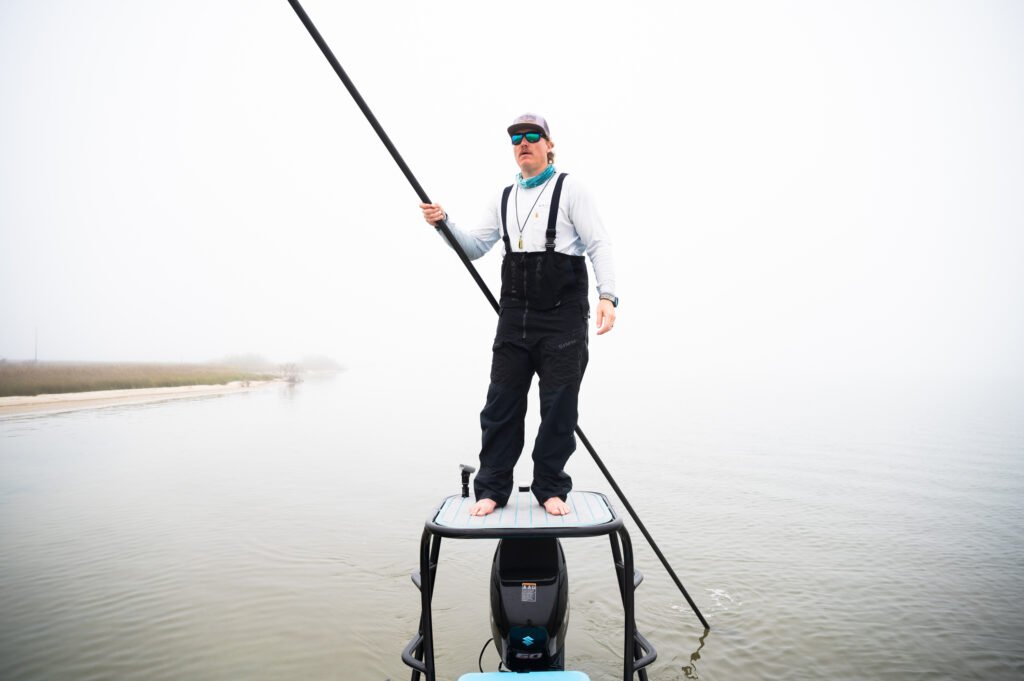
After guiding at destinations throughout the world, Jako decided to make Texas his home base in 2016. Texas doesn’t exactly entice anglers like the Seychelles, so it was a surprise for many that this was where he settled down. As soon as he got situated, Jako bought a flats boat for the famed redfish flats of Coastal Texas. And to twist the plot even further, redfish weren’t his focus. It was the crevalle jack that grabbed his attention.
And while that bewildered many of his friends, it equally surprised Jako. After catching a few jacks, he realized how similar of a feeling it was to catching GTs, and it made him wonder why more anglers weren’t interested in hunting jacks. And he thought jacks should garner the same explosive excitement and attention that the giant trevally did in his film Gangster of the Flats, when it was recognized at The Drake Fly Fishing Film Awards and the crowd went wild, standing up and cheering while watching the eats and their aggression.
It’s by no means a stretch to compare jacks to geets. Both species of fish are in fact in the same family, and anglers and early discoverers of these fish alike have both confused the two. Nowadays, with so much media available, an abundance of images and videos allow for plenty of side-by-side comparisons that show natural physical differences, though a silhouette view of each fish might make identification of each species challenging for many. The general shape of each fish is fairly similar. Minor differences include subtle aspects of their fins and color. Like with any fish, there are some behavioral differences, but overall, a list of similarities between jacks and giant trevally might far outweigh the differences. And that said, jacks are then a very impressive fish.
“I’ve always kind of said if you put a jack and a GT tail-to-tail, and you tie a rope there in the middle, it’s going to be a very tough battle. A jack’s like a racing snake. A GT obviously has that girth and that wideness to it,” says Jako. “But pound for pound, I think a GT’s going to have a tough time pulling a jack backward. I think it’s going to be a very close race. And some days I feel like a jack will win. I’ve had clients fight jacks legitimately for 45 minutes. Granted there is some current around and they can go deep, but they are a phenomenally strong fish with a lot of stamina.”
Perhaps many anglers are taking jacks for granted. RA would certainly say so. He has had experience with giant trevally and sees the obvious comparisons with jacks. “It does seem very bizarre to see GTs put on a pedestal, yet jacks are looked down on,” he says. “I remember seeing a social media video of a few anglers catching jacks and feeding them to alligators because they were unhappy to catch them. This sort of thing has always rubbed me the wrong way. Every fish deserves respect and appreciation. Just because it’s not a ‘target species’ is not grounds to disrespect an animal.”
One reason some anglers snub their nose at jacks is because of the belief that they are easy to catch. And frankly, they can be. But this can be a good thing; jacks are a great species for anglers getting into saltwater fly fishing. “For anglers transitioning from freshwater to salt, or just starting out in salt, there’s a big learning curve,” says RA. “The fish move faster, the targets are more demanding, and contending with wind and the elements can be tough on new anglers. Obviously, the best way to learn anything is through repetition and practice.
Opportunity, or shots at fish, is how we all learn valuable success and failure. We blow casts, we make casts. We set the hook correctly sometimes, and mess them up countless times. The point is simple, anglers need ample opportunity to grow their skills. If you start your saltwater career focused on tougher species, like permit or even some bonefish, you might not get as many shots as needed to grow quickly as an angler. Jacks present enthusiastic targets who can be forgiving with casting accuracy, are ready and excited to eat flies, and put anglers to the test when fighting fish. Plus, jacks grow to great fly-rod size and the visual nature of the ‘eats’ is exciting for anglers of any ability. Overall, I would highly recommend jacks to any angler looking for a great fly rod target. Plus, they are found in so many regional waters and much closer to home than many GT fisheries.”
As a guide, Jako loves guiding for jacks for similar reasons. As he puts it: “From a guiding perspective, jacks are gold. They are probably the fish that makes my guiding day the easiest of any fish that I guide for just because of that adrenaline rush, run and gun chasing. They eat on top. They just do everything. They fight super hard. They have every single element that a GT and any of those game fish possess.”
And whether you’re a client, guide, or angler, these fish are just downright thrilling — but they can also be challenging. “The challenging thing with guiding is the emphasis that we put on them now on how good they eat, and aggressive they are. They’re an angler’s dreams,” says Jako. “But they’re not always super easy to catch. When you find them in a situation where they’re just busting and going wild, that’s when you put your fly in there. Sometimes [clients] get … tunnel vision. They get so fixated on the specific baits that jacks are eating, whether there’s ribbon fish, gigantic mullet, and so on — but you’d better be presenting the right fly. And then the other thing that anglers sometimes misunderstand is that because [jacks are] so aggressive, they feel like they should catch them every time they cast a fly.
But jacks are a fish that are always on the move, always trying to go in a specific direction. You have to be ready with your cast and ready to get it in front of them within split seconds,” he adds. “And I mean, it’s a split second that can make the difference whether you catch a jack or don’t catch a jack.”
While many coastal towns along the Atlantic Ocean, the Gulf of Mexico, and the Pacific Ocean from California into Central and northern South America might have resident jacks that hang out around marinas like pigeons at a park, an angler can make the game as challenging as they want to. Sure you can cast a Clouser under a dock where jacks are used to eating fish scraps, but you can also get out and hunt the big fish that can be hard to find. For Jako, finding good fish means being on the move.
“So the situation for jacks usually ends up being what I call ‘run and gun.’ You kind of go to specific areas where you hope or you think you’d find them. Usually it’s places with a big volume of bait fish that get moved in by specific currents and tides. So then you go to those areas obviously hoping that you’d find them. Some days they’re not there, which completely blows my mind, but more often than not they’re going to be where the food is.”
And this is when the fishing tends to get intense.
“And it’s literally when you see those jacks in the distance. It looks like somebody’s throwing refrigerators in the water,” explains Jako. “It’s these massive blowups; they are just destroying everything. I mean, it must be the most terrifying thing on this planet being a bait fish in that zone … they’re living on borrowed time, because a jack’s eyesight is phenomenal.”
For Jako, this explosive action illustrates other similarities between jacks and geets. “ They can find stuff,” he says. “I’ve seen them track a baitfish, it flies up in the air, they still track it down with their eyes while it’s in the air. They track it and as soon as it lands, the jack strikes … so the eyesight’s really good. We generally run after these fish, try to get in front of it in a specific way, and then kind of float towards it. When the fly is where it needs to be, you strip as fast as you possibly can, and then hopefully you get a hook set and then it’s 100% important that you strip set the heck out of it. I always say to rip the face off the fish when you set the fly as hard as you can, because their mouths are also just as hard as those on a GT. So you really have to penetrate that hook somewhere in those really hard lips. And because their mouths are so big, I always find jacks or GTs almost engulf their prey. If you can manage that chaos, you’ll be pretty good.”
The similarities between jacks and giant trevally are seemingly endless, and RA and Jako don’t have any trouble selling the excitement of jacks to fly anglers. However, at least for now, each fish is treated radically different by the angling community, but that’s why they made JACKS — to show anglers that they can have epic battles and some of the best thrills on a fly rod hunting this remarkable fish that’s so much closer to home.
A giant trevally trip is at the top of many anglers’ bucket lists, and for good reason. But from North America, a trip to the Seychelles and back requires four travel days and an extraordinary amount of money. The experience might be as good as it gets with anglers fishing expansive flats for these aggressive and strong predators. Yet strangely, fly fishing for trophy jacks might be just a ride down the road for millions of anglers in the U.S., and taking on these thrilling fish might not even cross most anglers’ minds. And if they do, it’s likely because they are the backup plan.
“How can people say that there’s all these things around the world that [they] can’t afford, but they’re not even looking right on their doorstep?” asks Jako. “It’s just bizarre to me. It’s just like you turn a blind eye to something that’s next to you because it’s close to you. Your favorite fishery in this world should be the one closest to you because that’s the one you can access. That’s the one that’s going to keep you going. But never forget about that dream, but focus on your doorstep. It’s right there.”
The new film JACKS is currently screening to audiences all over Canada and the United States in the International Fly Fishing Film Festival. And you never know — like with Jako’s early films about giant trevally, maybe anglers will be standing on tables and screaming at the screen for jacks. And perhaps Jako’s passion and enthusiasm will inspire Indian Ocean-focused anglers to realize there’s a fish that is equally as impressive in their own home waters.
Lesson 11 brought to you by Fly Fusion contributor RA Beattie and Tim Harden. This article was originally published Volume 20, Issue 3 (Summer 2023)