

Fly fishing is a niche activity. Although statistics looking at fishing activities during the pandemic shows an uptake in interest, it is still estimated that only about 2% of the North American population are considered fly anglers. Furthermore, our small community is branched out into four main categories, adding another nuance to this already specialized fishing style. These four categories are dry fly fishing, nymphing, stillwater fishing and streamer fishing. Although many people will flow from one discipline to another without a second thought, the specialist may swear by one and claim that their craft is the only true flyfishing technique and that anything else, is just a variation on gear fishing. You dry purists know who I’m talking about. This philosophical claim is certainly a great topic for discussion, but not one I’m going to get into this time around.
One thing is clear to me; modern fly fishing and fly patterns are borrowing more and more from the world of gear fishing. This has become possible mostly by innovations in fishing equipment and tying materials. Over the past three decades, we’ve seen some important developments of new tying materials. More and more synthetics are now available. Walk into any well stocked flyshop today and you’ll be delighted (or overwhelmed) by the plethora of light and hydrophobic materials available. There are isles after isles of craft fur, chenille, latex, wiggle tails and rubber legs, to name a few. Browse for hooks online and you will notice that there are some specialized hooks that were designed for specific fly patterns. It is those kinds of advances that allowed for the creation of bigger and bigger flies. Flies that have less to do with mimicking insects and more to do with mimicking baitfish. Less to do with the tradition of small dry flies and increasingly encroaching into the dark territory of the spoons, the jerk-baits, and the swimbaits.
We can all agree that there is something magical about a trout rising to a parachute Adams. We can also probably agree that little else compares to nymphing when you’re going for numbers. Setting magic and numbers aside, nothing in my mind compares to sight fishing with streamers to get the adrenaline going. To see that large bull trout come out from the deep and give chase to a large streamer. Everything is there, the sighting, the chase, the take, the fight and the large predator fish. Streamer fishing is an active fishing technique. You hunt the hunter. You’re looking for the smartest, largest fish in the system.
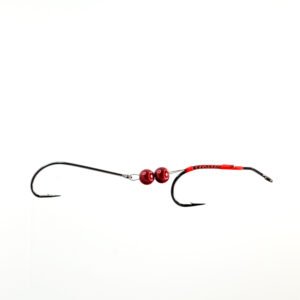
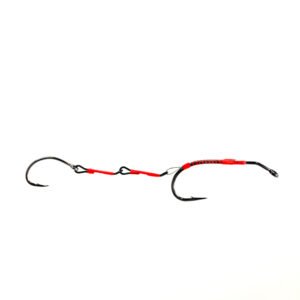
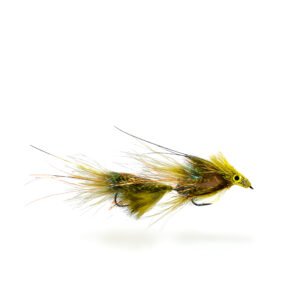
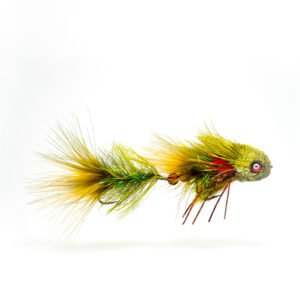
Thirty years ago, large streamers were the equivalent of a size 6 wooly bugger. Today, some pike flies, such as the Mega Glider, are upwards of 18 inches. Obviously, there has been many challenges is creating such large flies and casting them. We owe the development of modern streamer patterns to fly tiers such as Russ Madden and Kelly Gallup, who pioneered the style in the 70s and 80s. Then more recently, Andreas Anderson, Blane Chocklett and Niklaus Bauer have added their contribution. Clearly the list of innovative and creative tiers that have pushed this style is much lengthier. Articulated streamers have become more popular over the past couple decades. They often have provocative names, flashy colours and large profiles. Articulation is also a common thread with contemporary streamer patterns. Some articulated flies are built by joining two hooks together with a wire, others by a series of specialized shanks. We’ll come back to the various methods of articulating a streamer later. No matter what the method for joining segments (known as platforms), they all aim to fill one specific function – enhancing movement. Streamers tied on a single hook are limited in the amount of movement they can produce. The gear angler always had the upper hand on what was possible in terms of presenting realistic swimming baitfish imitations. In part because of the multiple articulations and the use of heavy construction material such as plastic and silicone. Another drawback of tying on a long single hook shank is the leverage it provides the fish. The chance of unhooking is greater the longer the shank is. Tying a fly over two or more platforms, allows you to create large flies without increasing leverage.
There are many ways of articulating a fly. The method you chose will be based on your local regulations, the size of the fly and the swimming pattern desired. Some regions will not allow for two hooks to be used. When this is the case, you must decide whether to place a larger hook at the front, followed by a few shorter shanks, or a larger shank at the front, followed by a smaller trailering hook. The decision should be based on the targeted species. Browns, rainbows, and pike for example, use different hunting and striking strategies.
The size of the fly will also help guide you in what hook/shank configuration is required. In my mind, any fly less than 8cm in length doesn’t warrant two hooks. The larger the fly, the more precautions should be taken to reduce undesired leverage.