

Masterclass: 8 Tips for Casting from a Driftboat

Walking and wading is probably the most common method of exploring moving water. Often there are more miles of stream available for wading than for floating, so the likely reason we hear so much about the difficulties in fishing from a drifting boat is anglers’ general inexperience in doing it.

It’s true it can be a challenge with so much going on. The boat is moving, the water is moving, someone is rowing and there’s probably another angler casting. And there’s your own fly line lying at your feet. You’re trying to look downstream to find the next target, you’re trying to stay stable on your feet through rough water, and all the while you’re trying to catch fish. But, it is a great way to fish in spite of the challenges. You can cover far more water than you ever would from your feet and you can fish the most productive water. It really isn’t that tough, especially if you follow a few simple principles.
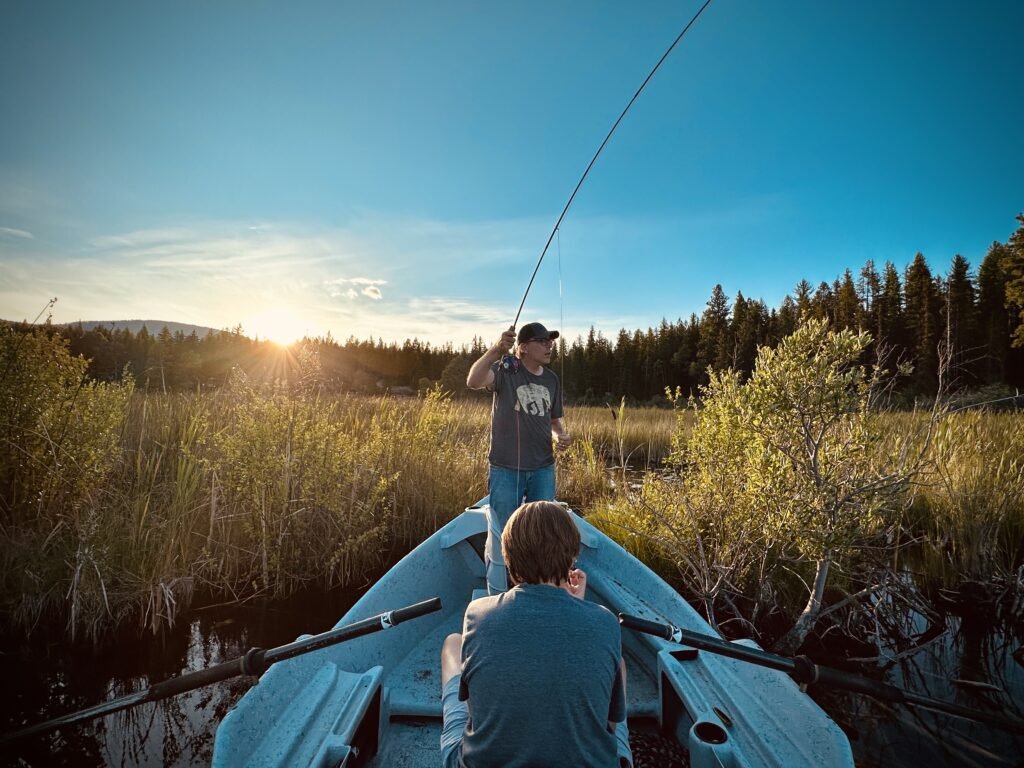
Before you begin, take a minute and look at your area in the boat. Be sure it’s well organized and free of potential line-snags like boat bags, extra rods, and clothing. When the fishing gets hot you don’t want to be fighting an obnoxious line snag that prevents you from focusing on your next cast.

The key here is not poaching the other angler’s water. The front angler generally has the advantage as he gets the first cast into new water. From the front of the boat he can cast in front of the boat and back as far as to the bank. Water behind that point (upstream) is the rear angler’s water. Most of the time both anglers should cast ahead of the boat so that as the boat moves, the fly line becomes shorter and the fly’s position more perpendicular to the angler.

Most anglers get into a regular casting rhythm if the water is somewhat homogeneous. Pay attention to this rhythm and to that of the other angler. This prevents losing time to tangled lines. If possible, alternate casts so you have clear air space. Mid-air collisions cause tangles, lost time, lost fish, and are frustrating for the person rowing the boat who must inevitably play the role of referee.

Talk to each other and listen to the guy at the oars. Not only is this a good safety measure but it’s also a great way to know when and where to cast.

But what about the actual casting? As noted earlier most casts will be made quartering downstream. But casting at general or random water is a sure way to reduce the number of fish you catch. Instead, choose a specific target. This not only increases your accuracy but also the effectiveness of your presentation. The target may be a rock       under the water, a seam of current, a shadow, a branch. Take into account the movement of the boat, the speed of the current, and if you’re fishing with sunken flies, the -rate of the flies and the depth of the water where the fish are holding. The faster and deeper the water the time you need. And in this case, time is distance. If you want the fly to sink to a depth of four feet by the time it reaches a particular spot, you need to cast further that spot than if you wanted the fly to sink to just two feet.

I know, I know… I’m the guy who constantly stretches the distance and pushes for more. However you’re in a boat, so use it. With the boat in the best position, a shorter cast requires less line and this reduces potential slack, improves line control and increases hook-ups. Along with this, fish a straight line. I know, I know… I write about fancy casts, aerial mends, and all kinds of non-straight-line casts. In a boat though, there’s a lot going on and all the variables increase the potential of unwanted slack and poor presentations. A simple short, straight-line cast is the ticket.

After you’ve made a cast to the right location with the proper lead-time, you need to manage the fly line. This is also where making a short cast at a consistent distance can be important. Casting nearly the same amount of line every time reduces the amount of line you need to handle. Having line at your feet that may get caught on the side of the boat, wrapped around an ankle or otherwise tangled will frustrate you and reduce your fishing time. It may also reduce your reaction time if after every cast you have to clear your line from the deck or unwrap it from the butt of the rod. It’s common to have fish eat a fly only moments after the fly enters the water. Keeping the line under control with little slack increases your hook-up rate.

Or at least, cast as little as possible. One of the great advantages of fishing from a boat is the fact that we’re moving with the current, drifting at the same rate as our flies. Every time we pick up to recast we waste valuable fishing time. It takes time to pick up from the water, make a    false cast or two, and finally deliver. So don’t re-cast until necessary, and limit the number of false casts between deliveries. Remember to look downstream, choose a landing spot that will give the longest drift, and then milk it for all it’s worth. You can only catch fish if your fly is in the water. If you’ve retrieved quite a bit of your line during its drift, one way to limit false casts is to let two to four feet of line slip into the rod as you begin your backcast/pickup. Then pinch the line with your rod hand and continue your backcast. This way you can add line before making forward cast.

Fishing from a boat is a special way to enjoy our sport, but not all the entertainment is in the water. Stop casting every once in a while, look up, take a deep breath and soak it all in. Most people remember the wildlife, the conversations, and the beauty of the day more than the fish they catch – unless of course it’s a big fish.

Lesson 14 brought to you by Fly Fusion Casting Field Editor Jeff Wagner.  This article was originally published Volume 15, Issue 4 (Fall 2018)