
Masterclass: Build Streamers That Move

Fly fishing is a niche activity. Although statistics looking at fishing activities during the pandemic shows an uptake in interest, it is still estimated that only about 2% of the North American population are considered fly anglers. Furthermore, our small community is branched out into four main categories, adding another nuance to this already specialized fishing style.  These four categories are dry fly fishing, nymphing, stillwater fishing and streamer fishing. Although many people will flow from one discipline to another without a second thought, the specialist may swear by one and claim that their craft is the only true flyfishing technique and that anything else, is just a variation on gear fishing. You dry purists know who I’m talking about. This philosophical claim is certainly a great topic for discussion, but not one I’m going to get into this time around.

One thing is clear to me; modern fly fishing and fly patterns are borrowing more and more from the world of gear fishing.  This has become possible mostly by innovations in fishing equipment and tying materials.  Over the past three decades, we’ve seen some important developments of new tying materials. More and more synthetics are now available. Walk into any well stocked flyshop today and you’ll be delighted (or overwhelmed) by the plethora of light and hydrophobic materials available. There are isles after isles of craft fur, chenille, latex, wiggle tails and rubber legs, to name a few. Browse for hooks online and you will notice that there are some specialized hooks that were designed for specific fly patterns. It is those kinds of advances that allowed for the creation of bigger and bigger flies. Flies that have less to do with mimicking insects and more to do with mimicking baitfish.  Less to do with the tradition of small dry flies and increasingly encroaching into the dark territory of the spoons, the jerk-baits, and the swimbaits.

We can all agree that there is something magical about a trout rising to a parachute Adams.  We can also probably agree that little else compares to nymphing when you’re going for numbers. Setting magic and numbers aside, nothing in my mind compares to sight fishing with streamers to get the adrenaline going. To see that large bull trout come out from the deep and give chase to a large streamer. Everything is there, the sighting, the chase, the take, the fight and the large predator fish. Streamer fishing is an active fishing technique.  You hunt the hunter. You’re looking for the smartest, largest fish in the system.

Thirty years ago, large streamers were the equivalent of a size 6 wooly bugger. Today, some pike flies, such as the Mega Glider, are upwards of 18 inches. Obviously, there has been many challenges is creating such large flies and casting them. We owe the development of modern streamer patterns to fly tiers such as Russ Madden and Kelly Gallup, who pioneered the style in the 70s and 80s.  Then more recently, Andreas Anderson, Blane Chocklett and Niklaus Bauer have added their contribution. Clearly the list of innovative and creative tiers that have pushed this style is much lengthier. Articulated streamers have become more popular over the past couple decades. They often have provocative names, flashy colours and large profiles. Articulation is also a common thread with contemporary streamer patterns.  Some articulated flies are built by joining two hooks together with a wire, others by a series of specialized shanks. We’ll come back to the various methods of articulating a streamer later. No matter what the method for joining segments (known as platforms), they all aim to fill one specific function – enhancing movement.  Streamers tied on a single hook are limited in the amount of movement they can produce.  The gear angler always had the upper hand on what was possible in terms of presenting realistic swimming baitfish imitations.  In part because of the multiple articulations and the use of heavy construction material such as plastic and silicone.  Another drawback of tying on a long single hook shank is the leverage it provides the fish. The chance of unhooking is greater the longer the shank is. Tying a fly over two or more platforms, allows you to create large flies without increasing leverage.

There are many ways of articulating a fly. The method you chose will be based on your local regulations, the size of the fly and the swimming pattern desired. Some regions will not allow for two hooks to be used.  When this is the case, you must decide whether to place a larger hook at the front, followed by a few shorter shanks, or a larger shank at the front, followed by a smaller trailering hook. The decision should be based on the targeted species. Browns, rainbows, and pike for example, use different hunting and striking strategies.

The size of the fly will also help guide you in what hook/shank configuration is required.  In my mind, any fly less than 8cm in length doesn’t warrant two hooks. The larger the fly, the more precautions should be taken to reduce undesired leverage.
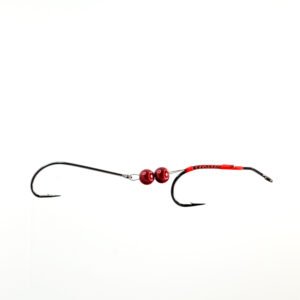
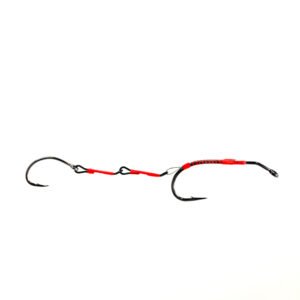
There are various ways of attaching platforms together. Braided lines allow for an outstanding amount of movement thanks to its flexibility, but it also eventually frays and is not foolproof when it comes to the toothier critters. Then there is the other end of the spectrum, titanium wire.  Popular in pike flies, this material is amazingly strong for its size and won’t fail on contact with the sharpest teeth.  It’s also extremely stiff and harder to work with. It’s somewhere in the middle where I tend to find what works best for most of my flies.  My articulated streamers are aimed at bull trout and rainbows.  I use braided wired such as Senyo’s intruder wire, or more recently, I’ve favoured Surflon Micro Supreme. Both options are nylon coated wires.  Surflon is braided, stiffer and slightly thinner. No matter what material you choose to join your platforms together, there will always be a risk of fouling.  Fouling happens either during casting or when the fly is swimming. Keeping false casting to a minimum (or not at all) should resolve the first issue, while threading the articulation wire through one or two 6mm beads will take care of the second. Below are examples of a couple different commonly used rigging techniques.

This is a standard rig set up.  For this particular configuration, the two hooks are joined with Surflon and 6mm beads are used to stiffen and separate the hooks.  The front hook should be bigger than the back to accommodate more material, promote movement and maintain alignment. More on this later.

This second rig is commonly use in Gamechanger style flies and for flies that are designed for fish that strike from the back.  It allows for more movement and features a shorter shank hook, reducing the chance of unhooking while fighting a fish. Where two hooks aren’t allowed, the front hook can be substituted for a Waddington type shank.  Alternatively, the rear hook can be switched for a smaller regular shank for articulated fly.  In this configuration, the two hooks are joined by a set of 15mm Fish Skull Fish spin shanks.

Now, lets talk about the elephant in the room.  The divisive existential reason behind articulated streamers – flies tied to imitate bait.  In other words, flies trying to do what lures are already doing so well.  For some fly anglers, this is a non-starter.  If you are still reading, hopefully you’re interested or at least intrigued. The articulation allows for movement but it’s not what makes the fly move like bait. If you were to just fish the hooks configuration bare, they would remain straight and probably sink too fast.  The movement is provided by the materials used and the order it is tied to each platform.  Firstly the fly must, like a fish, be tapered.  The heavier and bulkier materials are tied on the front. The idea is to create turbulence, and this is achieved by head and collar pushing through water.  That turbulence in return will activate the rest for the fly, moving each section of section independently. Using long wispy fibers such as marabou, craft fur, schlappen or chenille, enhances the action of the shank.  It also creates a bulkier profile without increasing weight.

A well tied articulated streamer is an irresistible instinctual visual trigger to most predatory fish.  Apart from stimulating the fish’s visual cortex, the water being pushed by the streamer’s head and large profile creates a wake that can be felt by the fish’s lateral line. This lateral line is the most sensitive and important biological function that a fish uses to detect a potential food source’s location, movement, and direction of travel.  The following patterns are design with that strategy in mind.

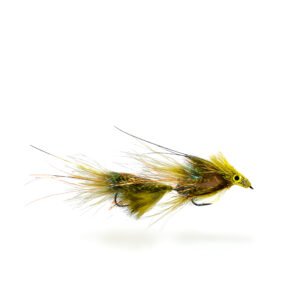
Drunk and Disorderly (Tommy Lynch):  Hands down my favorite pattern for bull trout.  This fly imitates an injured or disoriented baitfish.  The flat head is angled down, acting like the lip on a Rapala lure. As you strip, water pushes down on the top of the head and the fly dives. This head angle is possible due to a specialized hook manufactured by Ahrex (TP650). The front third of this hook has a 26-degree downward bend. The dive is immediately followed by a right (or left) turn depending on the strip angle and water current. The reaction of most people the first time fishing this pattern is usually along the lines of “this fly swims like crap!”.  That reaction is when you know you’ve tied a great Drunk and Disorderly. I should swim erratically.

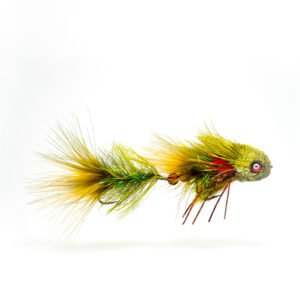
The Sex Dungeon (Kelly Gallup):  One of the first generation of articulated streamer and still one of the best.  Tied on a two-hook rig, it uses very light materials on the rear and heavy bulky materials at the front.  This is a true water pusher, and its main function is to maximize water disturbance and tail wiggle.  It rarely goes unnoticed.

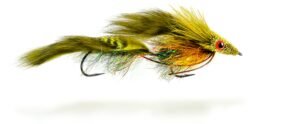
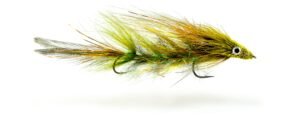
The next two patterns are by Andreas Anderson.  Both serve similar functions but are tied using different materials.  These two flies are a good example of how modern, synthetic materials have changed the world of streamer fishing.  The SID (yes, it’s named after that sloth in the animated film Ice Age) and the Unholy Diver are meant to dive upon each strip.  They are of course both articulated, so there is some great tail movement and the fly sway to one side or the other after each strip.  The difference between both flies start at the base.  The Unholy Diver is tied onto the multiple shank configuration displayed earlier, while the SID is on a double hook setup.  The next, and most important difference is the use of materials and how this difference highlight how new synthetics have moved this style of fishing forward. The SID is tied using rabbit strips and arctic fox.  The Unholy diver is tied using waterproof craft fur.  Both flies do have a base of chenille, used to prop up the other materials and help provide the illusion of bulk.

Both look amazing under water.  You don’t have to take my word for it. there are YouTube underwater videos of both flies in action.  The big difference is weight, especially wet weight. The SID’s natural material soak and retain water, making the fly heavy and tougher to cast. Alternatively, the Unholy Diver sheds moisture as soon as it gets into the back cast.  This waterproofness of materials allows for larger flies that are easier to cast and are more durable.  Since synthetic materials will rot (apart from the deer hair head) the fly can potentially last a lot longer. A lighter streamer also makes for a more enjoyable casting experience.  If you’re anything like me, your shoulder will thank you at the end of the day. Of course, you can always get a heavier rod and purpose-built lines to chuck those super meaty flies effortlessly. Most manufacturer now offer 7-9 wt. predator rods and heavily forward weighted lines that will turn any streamer you tie on.

Whether you associate or not with the “meat the hatch” or “junk stripping” community, it is undeniable that new methods of flyfishing are evolving.  Clearly, this trend is in part possible due to the development of modern tying materials.  The North American market has seen an increase of over 100,000 new fly anglers during the pandemic.  Everyday, new Instagram accounts are being created that showcase the work of new fly tyers.  Some fly shop owners are bringing in more materials after seeing a resurgence in interest. Is fly tying the greatest old thing again? I think so, but hey I may be slightly bias.

Lesson 5 brought to you by Fly Fusion Field Editor Frank Brassard.  This article was originally published Volume 19, Issue 3 (Summer 2022)