
Masterclass: Three Big Bugs for Summer

When most lake fishers think of spring, I believe they dream of ice melting away and wonder which chironomid pattern will work best on opening day. They’ve been dusting off their float tubes and checking their waders for holes. Their rods have been out for weeks, every fly line cleaned and every reel oiled to perfection. The long drought, also known as winter, is finally coming to an end and it’s time to get back on the water.

Not for me, though. My mind is elsewhere. I’m dreaming of high summer and wet-wading the rivers and streams of glacial tributaries, where I can leave civilization behind. I’ll be getting up early to start the trek to a spot I’ve been eyeing on Google Earth all winter long, wondering if it’s everything I thought it would be.

I can envision it now. A hungry trout lurks under a cutbank, waiting for my fly that may be comically large. I know where to place my cast so the fly will drift as perfectly as possible. I keep my eye on the fly as it makes its landing across the river. I then watch it dance on the surface, spiralling in the current. I steady myself to set the hook at just the right moment but not a second too soon. This is what I think about when springtime arrives. My heart can barely take it.

No flies suit summer better than big foam bugs. Over the years I have either tried or tied a large number of these flies. Some I’ve had great success with and others just seemed like a fad. Some were created with very specific imitations in mind, while others looked like they would never work, yet somehow did.
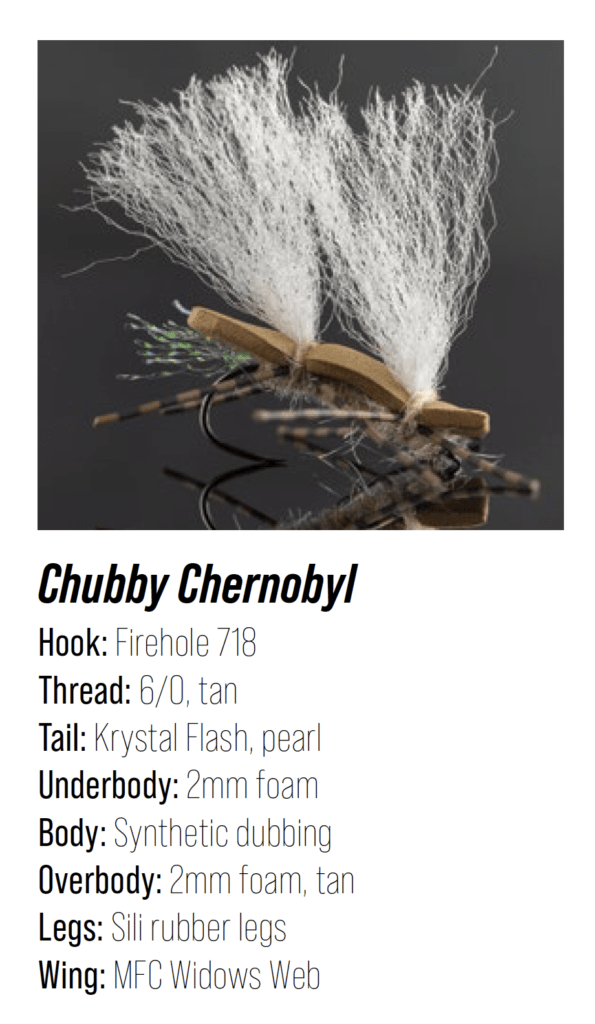
Chubby Chernobyl

I’m not sure you’re allowed to write about foam flies without talking about the Chubby Chernobyl. It’s a pattern that simply catches fish and is also relatively quick and easy to tie. One of the features I like are the huge poly wings that make it easy to see. Depending on size, colour, and time of year, the Chubby can pass as a hopper, a salmon fly, a golden stone or even a large caddis. If your regulations allow, it’s the perfect fly for a hopper/dropper rig.

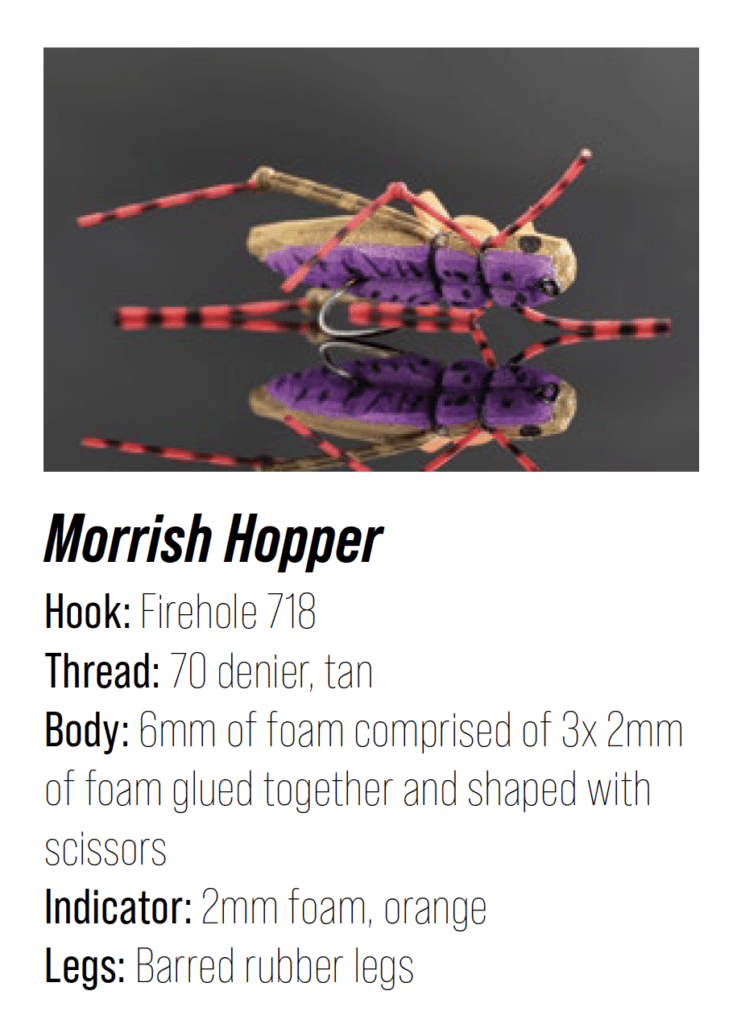
Morrish Hopper

I’m not sure if this is a classic foam fly yet, but I don’t think it will be long before it’s regarded that way. The profile on the Morrish Hopper is everything. From underneath it shows the same profile as a real grasshopper. I like to get a little fancy with the bottom of the fly and add some spots and lines with a marker to break up the flat mono-colour of the foam, but that’s personal preference. The fly is not difficult, though it can be quite time-consuming, especially if you’re gluing and shaping the foam by hand. River Road Creations has recently created a cutter set to vastly speed up the process if you plan to tie a lot of them.

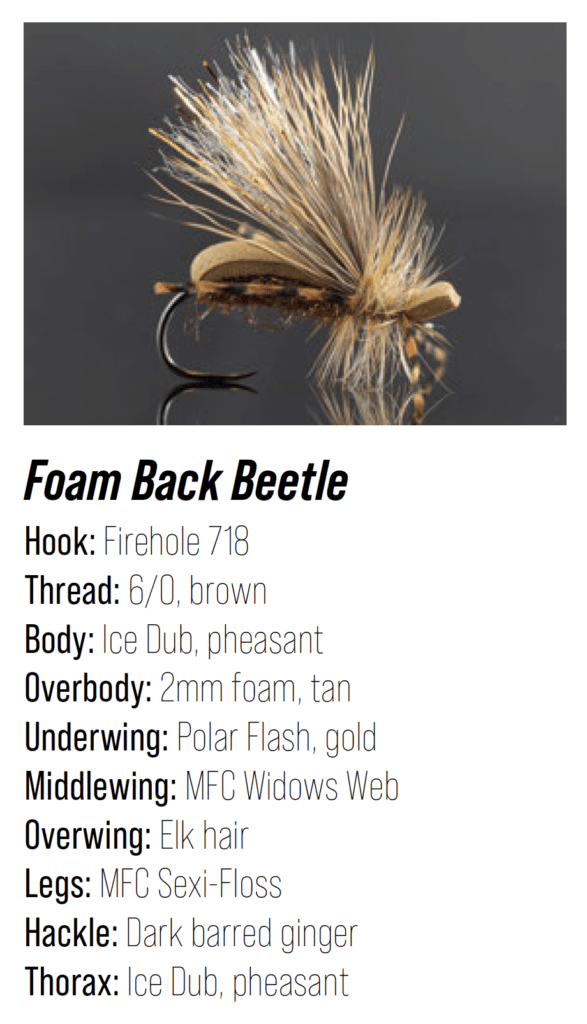
Foam Back Beetle

I can’t recall exactly where I saw this pattern, but when I did, I knew I had to tie it and try it. It has since become one of my confidence patterns for westslope cutthroats. These fish seem to have a soft spot for a well-presented beetle pattern. Many foam patterns use round rubber legs but for this one I prefer MFC Sexi-Floss, as it’s thinner and moves on the surface more easily. This fly is easy to see no matter where you cast it.

Lesson 5 brought to you by Fly Fusion contributor Dana Harrison.  This article was originally published Volume 17, Issue 2 (Spring 2020)