


By Al “Doc” Mehl
All things considered, when it comes to casting a fly, my school chum Chuck Monninger was the best I’ve ever known. Even though it’s been 50 years, I still remember one Chuck Monninger cast like it was yesterday. On East Elk Creek in western Colorado, Chuck was demonstrating fly casting to our mutual friend (and then-novice fly angler) Bear Miller.
“Just below the jagged yellow rock, tucked in behind the driftwood snag, with that sweet twisting current on the left and calm water in the crease, that seems a likely hold for Mr. Trout,” Chuck chuckled softly to Bear. Then, from 60 feet away, he deftly delivered a No. 16 Adams inside the 12-inch target zone, a cast instantly rewarded by the convincing strike of a 10-inch cutthroat. Bear shook his head in disbelief, then started his own tiresome day of clumsy greenhorn fly casting.
Yes, Chuck was as good as they get. Even so, I’d have to think that Chuck would be shaking his own head in amazement if he’d been in Montana to witness, a half-century later, the best cast of my fly-fishing life. And, in an unplanned homage to Chuck, I was fishing a No. 16 Adams.
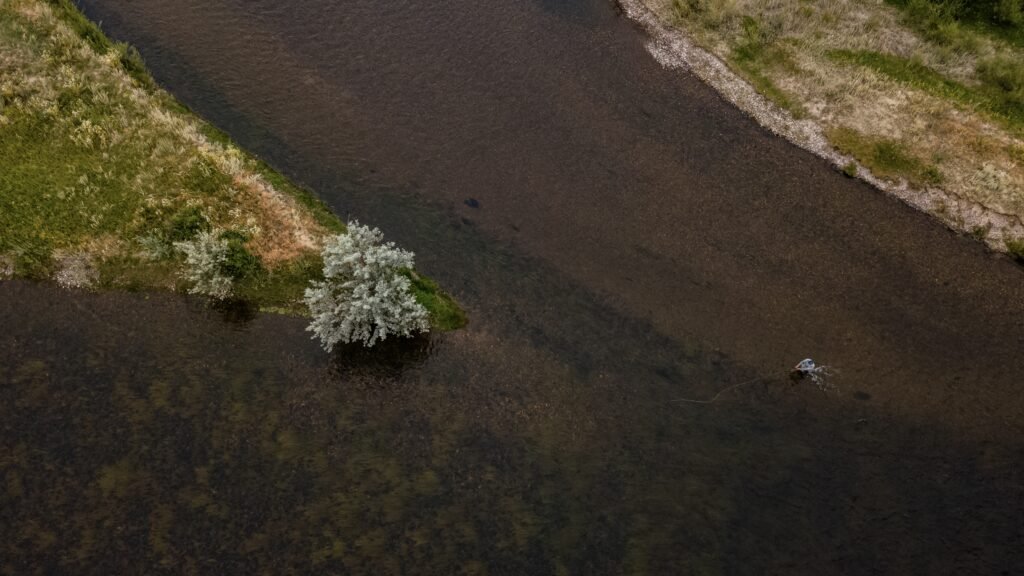
I’d spent the month of July doing some weekday temp work in Helena, and that left the weekends open for exploring the local fisheries. On a blue-sky Saturday, I was fishing the North Fork of the Blackfoot River. By midafternoon, I had landed four rambunctious rainbows, all of them from the long, deep hole a few hundred yards above the canyon bridge, a pool that I’d discovered during the previous month’s explorations.
I might have kept fishing well into the evening if I hadn’t found myself fighting a chilly, freshening wind from the north. Maybe, I thought to myself, it’s time to call it a day, scramble up the scree embankment to the still-warm car sitting in the high summer sun, and find my way to a local watering hole to toast my successful outing with a beer.
I reeled in. With only a few feet of fly line and 7 feet of leader remaining on the water, a sudden gust of that north wind swung around behind me and lifted my trusty Tilley hat from my head. Just out of reach, the hat hovered at eye level for a split second and then jumped onto the wings of that wind gust, landing upside down 25 feet away in the middle of the riffles that coursed along the left side of that honey hole.
The current arced away from me. Soon, my hat was 40 feet away and turning to the right. In mere seconds the current would pick up speed at the tail end of the pool, and my hat would tip over the splashing falls and drown, forever lost.
My hat size, you might now ask? 7 3/8.
The oval outline of that Tilley hat in the water took on the look of a skewed archery target, the khaki-colored outer ring enclosing the 7 3/8-inch mountain-snowmelt-blue bull’s-eye, a target that was creeping ever farther away.
My hat was a goner. Damn. Unless …
Lifting my fly rod instinctively, I snapped the fly line toward me into an abbreviated backcast. As the line hovered behind me, I stripped a great armful of line from the reel and loaded it forward in a false cast. The hat was almost 50 feet away now and swinging left to right. I made another backcast, reloading another stripping armful of fly line onto the second false cast.
Watching that serenely drifting archery target was tantalizing. I have never tried archery. I’m told it’s all about breathing, about focus, about the Zen of mind-body calmness. Stripping line wildly from the reel, precariously flailing my graphite fly rod to and fro, cursing out loud about the favorite fishing hat I was about to lose forever, I was anything but Zen calm.
I loaded another strip of line into the backcast as the fly reel sang out its siren song in a higher key than ever before. Momentarily I wondered if my backcast would now be traipsing through the riverside willows, a No. 16 Adams soon to be snapped off by an innocent-enough twig. But this was not the time to worry about a $1.59 dry fly when an $89 hat was about to disappear.
On the third forceful false cast, my fly line was now extended and hovering 50 feet in front of me. And the hat? It now drifted 60 feet in front of me, picking up speed in its left-to-right journey out of my life. If I had been standing on the opposite bank, I might have been close enough to lean in and grab the sucker, but alas, I was not on the opposite bank.
I stripped line from the reel again, dug my shoulder and upper arm deeply into one more great backcast, and took aim. But where to aim? My hat was now a pheasant on the wing, and the savvy hunter knows to swing the gunsight past the flying bird and place the buckshot into the bird’s flight path. I started my forward cast knowing this was my chance, in fact, my only chance.
I have never entered a fishing tournament. Fishing tournaments are meant for talented and serious fishermen like Chuck, and not for recreational fishermen like me. Still, if I were to enter a fishing tournament someday, I have always been intrigued by the idea of a one-fly fishing tournament. How terribly cautious must one be with the backcast? How close to the snag must one dare drift to catch fish without losing the critical fly? What fly to pick if you can only pick one? For me, perhaps a No. 16 Adams.
But even more challenging than a one-fly contest, I had now been unwittingly entered in a one-cast contest. The end was at hand. There would be time enough only for a single cast to hit the drifting target. Win or lose, this contest would be one and done.
I let the last handful of stripped line sing through the guides as the double-tapered fly line carried the newest of its now 60-foot length away from me. Then, with the confidence borne of a lifetime of fishing, I paused my breathing in Zen-like anticipation of the final artistic brushstroke. I calmly swept the rod tip gently to the right of the target. The extended fly line and attached leader responded like the lead pair of an eight-horse team, veering ever so slightly in the direction that the driver’s reins had requested. The fly rolled over the final feet of that long cast as I leaned as far forward as I dared. I extended my casting arm fully, added a few extra inches to the cast by swinging my opposite leg backward and flexing at the waist in a balanced, ballet-like maneuver, then willed the No. 16 Adams to land gently on the water.
That battered dry fly settled proudly on the calm water inside the bull’s-eye.
I marveled at the once-in-a-lifetime cast. Oh, if only Chuck Monninger could see me now. And then, before even one more heartbeat, the spell was broken by the realization that a No. 16 hook has a bend that measures less than 1/8 inch. Even perfectly placed inside the crown of the floating hat, what might be the odds of that hook finding purchase in the fabric of the hat, relinking me with my lost lid?
But purchase it did find. Unbelievably, the hook embedded itself into the swirling neck strap that had been floating serpentlike within the bull’s-eye of the crown — the neck strap that is designed to keep the hat from blowing off in the wind, if only the fisherman remembers to wear the strap properly when the wind picks up.
Having nearly claimed the gold medal in this day’s one-cast fishing tournament, I now found myself enrolled in the subsequent one-fly tournament extension. I had hooked a lunker, and it pulled hard in the current, hoping to make its escape by exiting the pool, entering the falls, and stealing the fly from the leader. Steadily, I pulled with an even flex in my rod, now trying to remember which tippet I had tied on hours before. Had it been 5X? Was it even finer, maybe 6X? Too much tension, and I would be snapping my only-hope fly from the line. Too little pull, and the hat would pass through the falls, breaking me off regardless.
Steady, slow and steady. Redirect. Turn the head of the beast. Slip the quarry from the strong current and coax him gently back into the pool. Ever so slowly, the battle was won. The hat put up a mighty battle, but by now had lost all fight. The long line was gradually retrieved, and I landed the monster without a net.
Better than a streamside photo of a long-played lunker now in hand, better than even a trophy mounted on the wall, that Tilley hat remains head-mounted to this day, still in service. It’s a living reminder of one more good day on the water. And it’s a beat-up, poignant keepsake of the very best cast of a lifetime.